No. 010 · 25 Sep 2026 · Money
The Pay Gap Isn’t $218 for Everyone. Ask Black and Hispanic Women.
When recent reports pointed to growing volatility for women in public-sector and government jobs, long considered one of the steadiest routes to equal pay and middle-class stability, they raised an urgent question: how secure are women’s economic gains in America today? In 2025, Black women lost about 156,000 public-sector jobs, most of them federal, according to an Economic Policy Institute analysis of Census Bureau survey data. Those are jobs where pay has been closer to equal: among federal workers, the gender gap had narrowed to 7 cents on the dollar by 2017, the Government Accountability Office found.
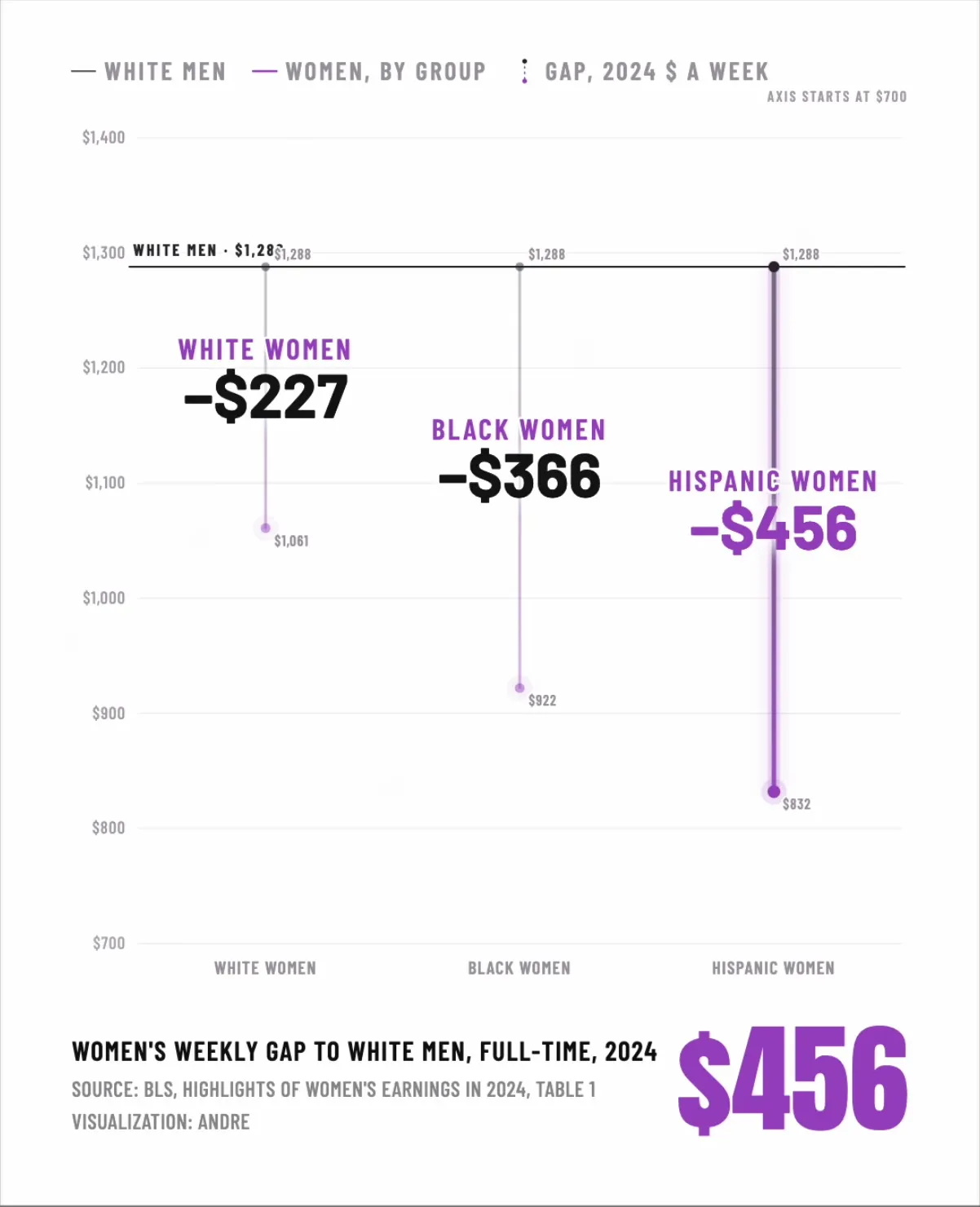
Digging into the latest Bureau of Labor Statistics numbers exposes a stark truth. The national pay gap, $218 a week between the median man and the median woman working full time, is an average that hides a steep racial cliff, and Hispanic women stand at the bottom of it. They earn $456 a week less than White men, roughly $23,700 over a year. No group BLS reports by race or ethnicity, women or men, is further behind. Black women earn $366 a week less, about $19,000 a year. Much of that distance is built into where they work: a 2024 Labor Department report estimated that being concentrated in lower-paying jobs cost Hispanic women $53.3 billion in wages in 2023, and Black women $42.7 billion, compared with White men.
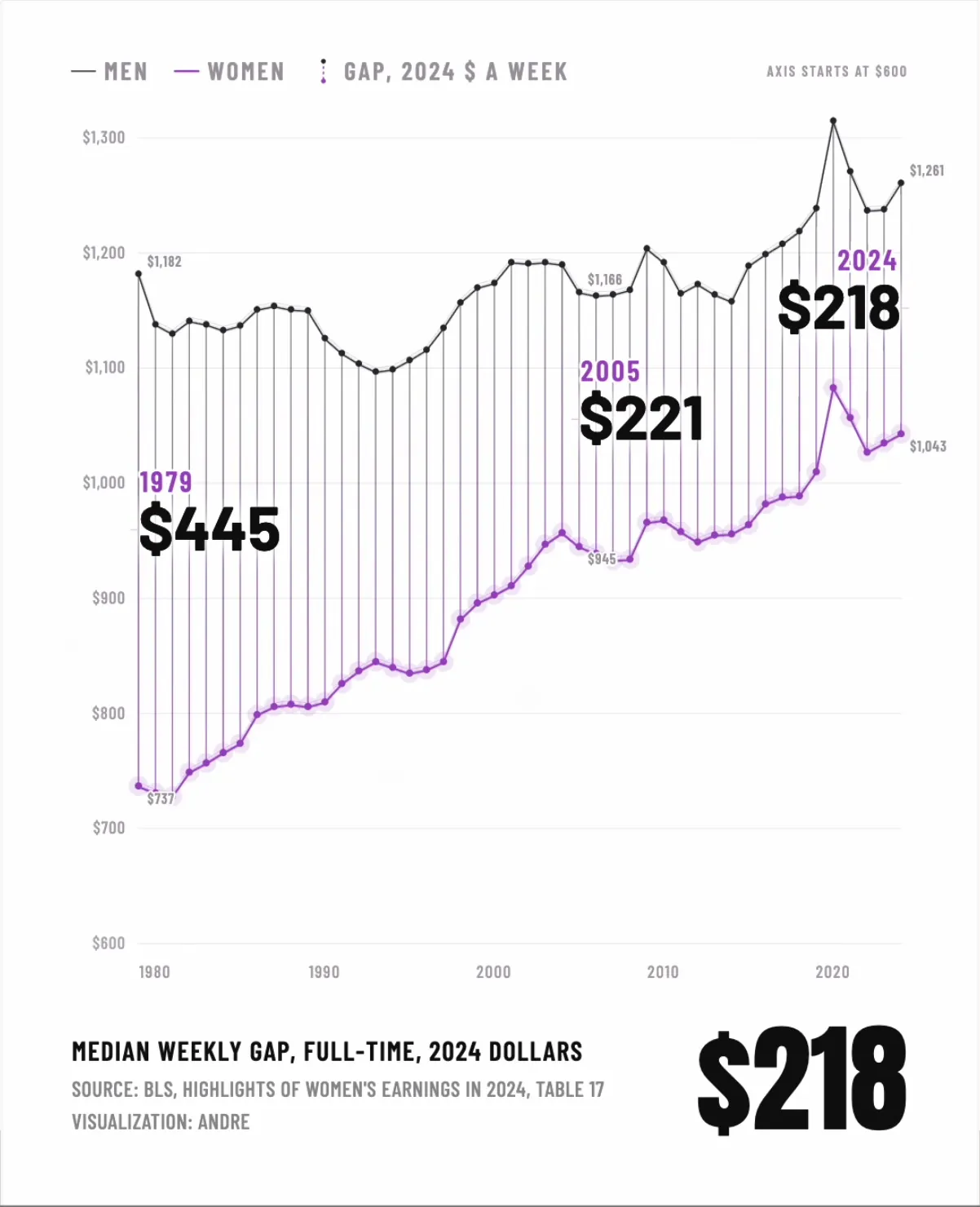
Across the whole workforce, the data reveals a second surprise: in dollar terms, the overall gap stopped closing two decades ago. In 2005, the typical woman working full time earned $221 a week less than the typical man, in today’s dollars. In 2024, the difference was $218.
Why did the overall progress grind to a halt?
- The male wage rebound: Between 1979 and 2005, men’s real pay stagnated, slipping 1% while women’s climbed 28%. Since 2005, women’s pay has kept rising, by about 10%, but men’s has risen about 8% too, so women now have to outpace a moving target rather than catch a stationary one.
- The “greedy work” bottleneck: Nobel laureate Claudia Goldin has shown that many high-paying fields, especially corporate, financial and legal work, pay a steep premium for long, inflexible hours, a premium that falls hardest on people with caregiving duties. The pattern shows at the top of the scale: among full-time workers with a bachelor’s degree, the weekly gap reaches $428, the widest of any education level.
For Black and Hispanic women, the pressures stack. They face the same premium on long hours as other women, plus a labor market that sorts them into lower-paying jobs. Every year since 1979, Hispanic women have had the lowest median pay of any race-and-sex group BLS tracks. And for Black women, the public-sector jobs that softened both pressures are the jobs they lost in large numbers in 2025.
What would move the needle:
- Targeted pay audits: Look beyond company-wide averages and audit pay by job title and level, tracking race, ethnicity and gender together.
- Decouple pay from overwork: Restructure roles around team coverage so that the ability to work 60-hour weeks is not a requirement for promotion.
- Protect and extend public-sector pay standards: Bring published salary bands and pay reporting into private firms. When Denmark required firms to report pay by gender, the gap narrowed by about 2 percentage points, mostly because men’s raises slowed.
- Report gaps in dollars, by group: Percentages blur the stakes, while “$456 a week” makes the structural failure hard to ignore.
This analysis doesn’t answer every question: occupational segregation across the private and public sectors, remote work’s effect on pay by group, and the gap for Native American women, whom this BLS report doesn’t break out, deserve their own issue. Share your thoughts, and any gaps this analysis misses, in the comments!
Sources
U.S. Bureau of Labor Statistics, Highlights of Women’s Earnings in 2024 (Chart 1; Tables 1, 15, 17 and 18), from the Current Population Survey, a monthly survey of about 60,000 households. Pay figures are median usual weekly earnings of full-time wage and salary workers in 2024 dollars (CPI-U-RS). They compare the median woman with the median man rather than pay for identical work, and the yearly figure is the weekly gap multiplied by 52. BLS race groups include Hispanics of that race, and Hispanic workers may be of any race. BLS does not report Native American women separately; National Women’s Law Center calculations from Census Bureau data put their full-time gap level with Hispanic women’s, at 58 cents per dollar paid to White, non-Hispanic men in 2024. U.S. Government Accountability Office, “Gender Pay Differences: The Pay Gap for Federal Workers Has Continued to Narrow, but Better Quality Data on Promotions Are Needed,” GAO-21-67, December 2020. Valerie Wilson, “Black women suffered large employment losses in 2025—particularly among college graduates and public-sector workers,” Economic Policy Institute (a labor-aligned think tank), February 2026, from Current Population Survey microdata. U.S. Department of Labor Women’s Bureau, Bearing the Cost, March 2024. National Women’s Law Center, “What’s Behind the Full-Time, Year-Round Gender Wage Gap Calculation?” fact sheet, January 2026. Claudia Goldin, “A Grand Gender Convergence: Its Last Chapter,” American Economic Review 104(4), 2014, and Career and Family (Princeton University Press, 2021). Morten Bennedsen, Elena Simintzi, Margarita Tsoutsoura and Daniel Wolfenzon, “Do Firms Respond to Gender Pay Gap Transparency?” Journal of Finance, 2022.