No. 008 · 11 Sep 2026 · Society
A Third of It Never Gets Eaten
We live in a country where close to one-third of the food that reaches our stores and kitchens—133 billion pounds a year—is never eaten. Seeing $161.6 billion in food wasted while USDA reports show 13.7% of U.S. households remain food insecure raises an immediate question: why isn’t our massive surplus feeding the hungry? The answer is far more complex than a simple supply-and-demand mismatch.
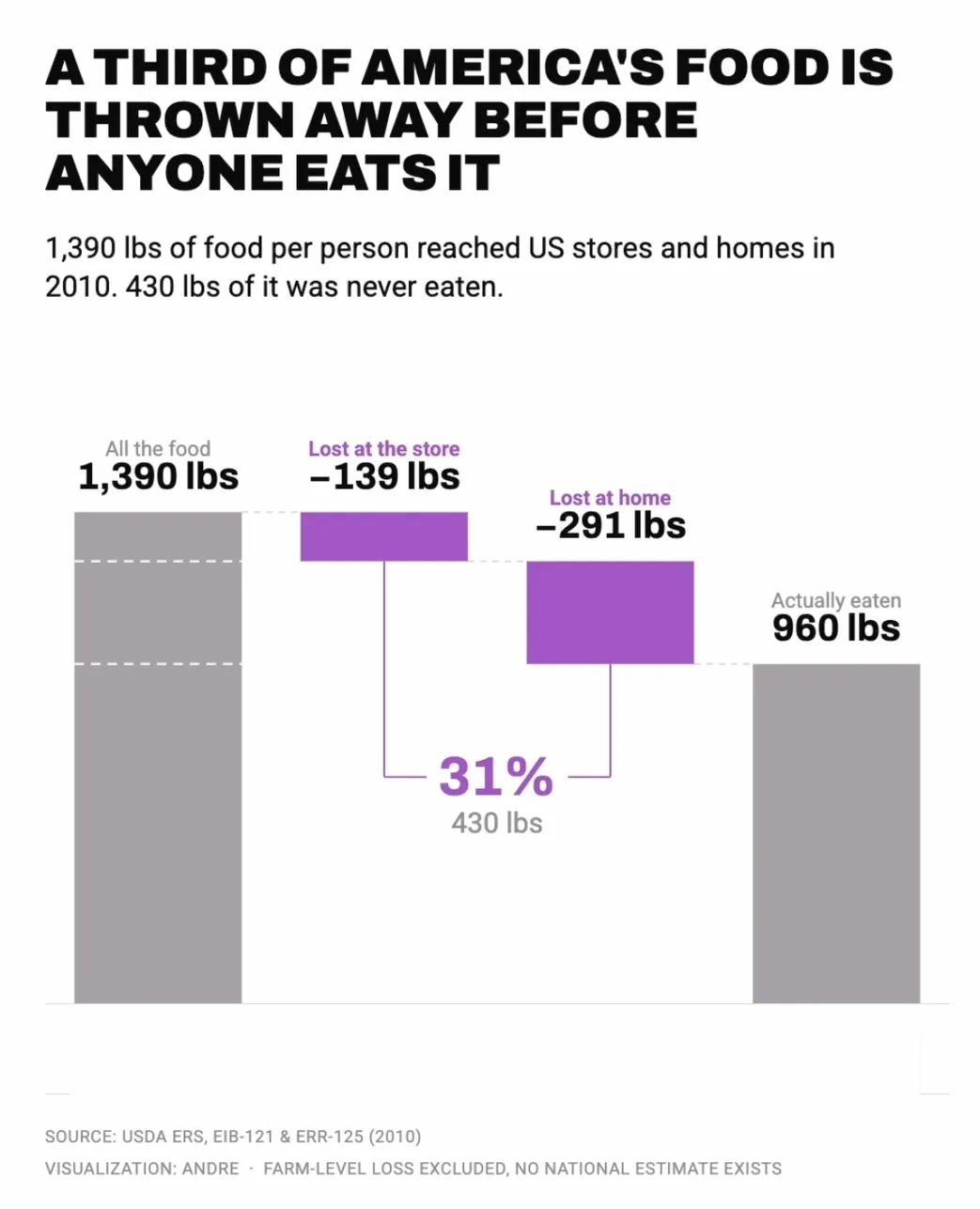
Digging into government research exposes that the bottleneck is economic and logistical, not a lack of physical food. USDA data shows 18.5% of fresh fruit is lost during farm-to-retail processing, and another 10% spoils on store shelves to maintain the visual illusion of endless abundance. Because moving perishable food to low-income neighborhoods costs distributors money, surplus sits in warehouses while hunger persists as an income and distribution problem.
The numbers on household habits reveal a similar misdirection. Consumers account for the single biggest slice of the waste—89.9 billion pounds, or 21% of everything that reaches a store or a kitchen—but the research fine print shows that roughly a quarter of produce “loss” is actually inedible trim like peels and pits. Saving scraps or being hyper-efficient in your own kitchen is great for your wallet, but it will never fix structural failures in the commercial supply chain or put food on an insecure family’s table.
Fixing this disconnect requires shifting our focus from personal guilt to systemic accountability:
- Separate thrift from hunger relief: Practice kitchen planning to cut your grocery bill, but recognize that household efficiency won’t solve systemic hunger—support policies that raise household income and fund food bank cold chains instead.
- Target commercial incentives: Advocate for tax credits and dumping penalties that force grocers to donate excess inventory before it spoils.
- Fund distribution infrastructure: Back food recovery networks equipped with refrigerated trucks to move surplus straight from warehouses to pantries.
- Shift retailer standards: Buy imperfect produce to push commercial chains away from wasteful overstocking practices.
Sources
USDA Economic Research Service, Buzby, Wells & Hyman, The Estimated Amount, Value, and Calories of Postharvest Food Losses at the Retail and Consumer Levels in the United States, EIB-121 (2014); USDA ERS, Food Availability (Per Capita) Data System, Loss-Adjusted Food Availability series, fruit, 2021; USDA ERS, Rabbitt et al., Household Food Security in the United States in 2024, ERR-358 (December 2025); USDA, “Food Loss at the Farm Level” (2019).
If you have any suggestions or ideas on how to address this gap, drop them in the comments!